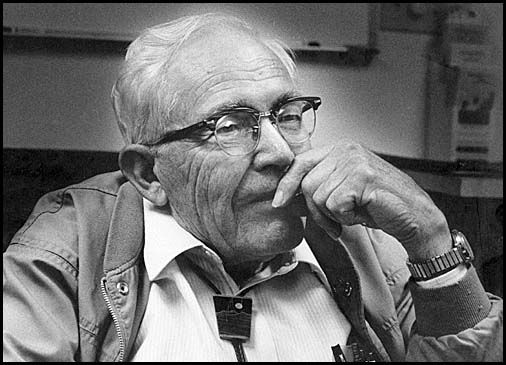
Born in 1906 in Streator, Illinois, Clyde became interested in astronomy through his uncle. In 1928, armed with a home made 9-inch f/9 reflector of superb optical quality, he made sketches of the planets, particularly Jupiter and Saturn. He sent copies of these sketches to Lowell Observatory, just to get their comments. In reply, V.M. Slipher, then Lowell's director, offered him a position at the observatory with the new 13-inch f/5 photographic camera. His mission: to take photographs of the sky in search of Percival Lowell's elusive planet X. A few months after he arrived, Slipher also assigned him the task of scanning the plates with a blink comparator. During the summer of 1929, Clyde recast the program for more efficient searching. On February 18 at 4 pm, Clyde was scanning a pair of plates centered on Delta Geminorum, when he noticed a 17tj magnitude speck of light shifting from plate to plate exactly as a trans-Neptunian planet should. On March 13, 1930, Lowell Observatory announced the discovery of the planet that would eventually be named Pluto to the world. But far from the ending, the discovery was only a beginning for Clyde. He continued the search for another 15 years, discovering a comet, 5 open clusters, a globular cluster, a supercluster of galaxies stretching from Andromeda to Perseus. In 1932 he discovered a nova in Corvus that had exploded a year earlier. While writing his biography, I uncovered the existence of the long forgotten discovery in his plate log. A subsequent check of more than 350 patrol plates at Harvard, which I did in the summer of 1989m, revealed that this star had gone into outburst an additional 9 times between 1931 and 1980, and on March 23, 1990, 59 years to the day after its first recorded outburst, I made the first visual observation of the star, now called TV Corvi, in outburst. After Clyde took a leave of absence for war-related navigation teaching, he was dismissed from Lowell in 1945, ostensibly for financial reasons. He began work in 1946 at White Sands Proving Grounds to develop the optical tracking telescopes for the fledgling space program. Some ten years later he founded the Astronomy program at New Mexico State University. After retiring in 1973, Clyde maintained a very active profile, giving lectures frequently. Between 1985 and 1990 he crisscrossed the continent, giving lectures to raise funds for the Tombaugh Scholars program at New Mexico State. So much for Clyde's accomplishments. Until the end, Clyde was an incredibly interesting person to be around. Famous for his puns, his command of the intricacies of the English language was astonishing. On January 17, 1997, astronomy lost one of its most colorful figures. If planet Pluto were sentient, it would take note of the loss of the man who unveiled its existence to our world almost 67 years ago. David Levy
Related sites:
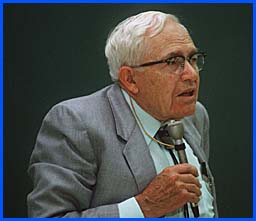 Photo by Vic Winter Clyde Tombaugh talked to members of the Astronomical
Society of Kansas City during a special meeting in June of 1988.
Photo by Vic Winter Clyde Tombaugh talked to members of the Astronomical
Society of Kansas City during a special meeting in June of 1988.
•Clyde W. Tombaugh:
The astronomer and his discovery
• The struggle
to find the ninth planet
•
The Clyde W. Tombaugh Observatory at the University of Kansas
• A great page with more
information and links about Clyde &
Pluto.
Clyde Tombaugh, the discoverer of the planet Pluto, died on Friday, January 17. He had suffered from congestive heart failure and was on oxygen for the last several years. Memorial services are scheduled for Thursday, January 23, at 3:30 in the Music Hall on the campus of New Mexico State University in Las Cruces. Below is a brief biography of Tombaugh provided by his close friend and fellow sky-searcher, David Levy.
Thanks to Alan Harris, on behalf of the DPS Committee for this information.
* Publishing and reproduction permissions for this photo may be obtained here.